Dual Study Programs in Germany
Table of Contents
- Types of Dual Study Programs in Germany
- Popular Dual Study Programs in Germany
- Best Universities with Dual Study Programs in Germany
- Top Companies with Dual Study Programs in Germany
- Salary During Dual Study Programs
- Eligibility Requirements for Dual Study Programs in Germany
- Admission Process for Dual Study Programs in Germany
- Intakes & Admission Timeline for Dual Study Programs in Germany
- Tuition Fees for Dual Study Programs in Germany
- Blocked Account Requirement
- Student Visa for Dual Study Programs
- Career Opportunities After Dual Study Programs in Germany
- Are Dual Study Programs Better Than Traditional Degrees?
- Author’s Final Thoughts
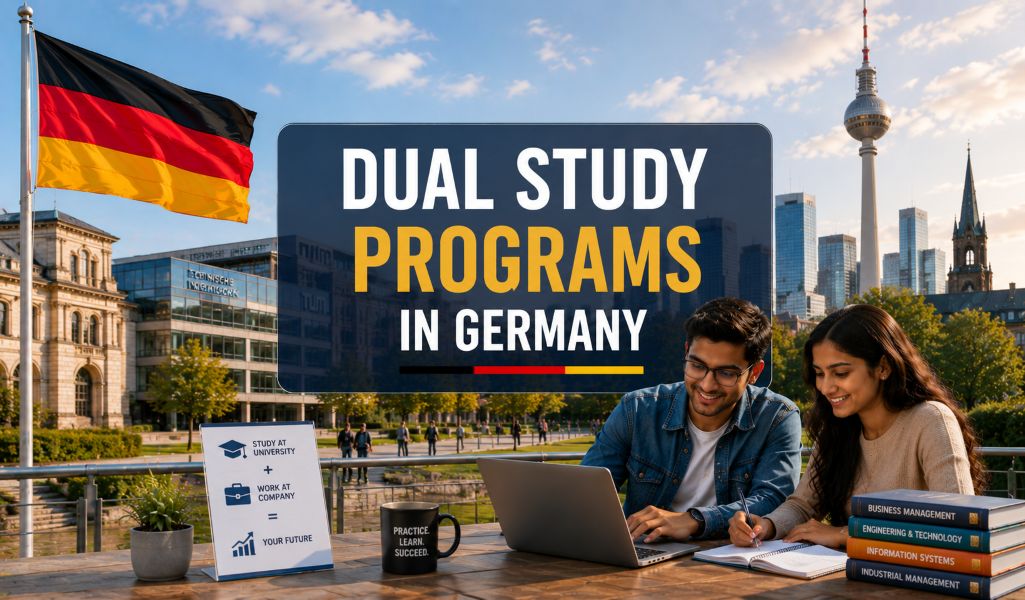
Dual Study Programs in Germany are the most attractive higher education pathways for international students, particularly those who want to combine academic learning with paid industry experience. Dual study programs integrate university education with practical training at a German company, allowing students to graduate with both academic qualifications and valuable professional experience.
Students enrolled in a dual study program typically receive a monthly salary ranging between €900 and €1,500+ (Approx. ₹90,000–₹1.5 lakh) while completing their bachelor's degree. Another major advantage is employability. Many participating companies offer full-time employment immediately after graduation, making dual study programs is Germany's strongest education-to-employment pathways.
Key Highlights
Particular | Details | Approximate INR |
Program Duration | 3–4 Years | — |
Monthly Student Salary | €900–€1,500+ | ₹90,000–₹1.5 lakh/month |
Tuition Fees | Mostly Tuition-free | Semester Fee Only |
Semester Contribution | €150–€350 | ₹15,000–₹35,000 |
German Language | B2–C1 | Mandatory |
Blocked Account | €11,904/year | Approx. ₹11.9 lakh |
Post-Graduation Employment | Often Offered by Employer | High Placement Rate |
This unique model has made Germany one of the few countries where students can simultaneously earn a degree, receive a salary, and develop practical workplace experience. However, admission is considerably different from regular university programs. Applicants must first secure a training or employment contract with a participating German company before enrolling at the partner university. Since most programs involve daily workplace communication, German language proficiency at B2–C1 level is usually mandatory.
Types of Dual Study Programs in Germany
Not every dual study program follows the same structure. German universities and companies offer different models depending on the industry and learning objectives.
The table below explains the major types.
Program Type | Best For | Outcome |
Training-Integrated | Fresh school graduates | Degree + Vocational Qualification |
Practice-Integrated | Students seeking corporate exposure | Degree + Extensive Work Experience |
Career-Integrated | Working professionals | Degree While Employed |
Training-integrated programs remain the most common option for international students pursuing bachelor's degrees.
Popular Dual Study Programs in Germany
Germany offers dual study opportunities across engineering, business, healthcare, logistics and technology disciplines. Engineering and business-related dual programs continue to attract the largest number of international applicants due to Germany's strong industrial economy.
The table below highlights some of the most popular options.
Course | Duration | Major Industry |
Mechanical Engineering | 3–4 Years | Manufacturing & Automotive |
Electrical Engineering | 3–4 Years | Energy & Electronics |
Computer Science | 3 Years | IT & Software |
Business Administration | 3 Years | Corporate & Finance |
Mechatronics | 3–4 Years | Automation & Robotics |
Healthcare Management | 3 Years | Healthcare Industry |
Logistics & Supply Chain | 3 Years | Transport & Logistics |
Nursing | 3 Years | Healthcare Services |
Best Universities with Dual Study Programs in Germany
Several German universities specialise in dual education and collaborate closely with leading employers.
The table below highlights some of the most recognised institutions.
University | City | Popular Programs |
Baden-Württemberg Cooperative State University (DHBW) | Multiple Campuses | Engineering, Business, IT |
HWR Berlin | Berlin | Business Administration, Public Administration |
Hochschule München | Munich | Engineering, Computer Science |
IU International University | Multiple Cities | Business, Management, Digital Programs |
Hochschule Bremen | Bremen | Engineering & Logistics |
Baden-Württemberg Cooperative State University (DHBW): DHBW is Germany's largest university dedicated exclusively to dual education. It partners with thousands of employers across engineering, business, healthcare, and information technology.
HWR Berlin: HWR Berlin offers internationally recognised business programs with strong employer collaboration, making it one of Germany's leading institutions for management-focused dual education.
Hochschule München: Located in Munich, Hochschule München collaborates extensively with engineering and manufacturing companies, providing excellent practical training opportunities.
IU International University: IU offers flexible dual study pathways in business, management, digital technologies, and healthcare, with a growing number of employer partnerships across Germany.
Top Companies with Dual Study Programs in Germany
The strength of Germany's dual education system largely comes from its close collaboration with globally recognised employers. These companies recruit dual study graduates into permanent positions immediately after successful completion of the program.
The table below lists some of the leading companies participating in dual study programs.
Company | Major Fields | Monthly Salary |
Siemens | Engineering, IT | €1,100–€1,500 (Approx. ₹1.1–1.5 lakh) |
Airbus | Aerospace Engineering | €1,100–€1,400 (Approx. ₹1.1–1.4 lakh) |
Bosch | Electronics & Engineering | €1,000–€1,400 (Approx. ₹1–1.4 lakh) |
BMW Group | Mechanical Engineering | €1,100–€1,500 (Approx. ₹1.1–1.5 lakh) |
Mercedes-Benz | Automotive Engineering | €1,100–€1,500 (Approx. ₹1.1–1.5 lakh) |
SAP | Computer Science & IT | €1,200–€1,500 (Approx. ₹1.2–1.5 lakh) |
Fresenius | Healthcare Management | €950–€1,300 (Approx. ₹95,000–₹1.3 lakh) |
Deutsche Bahn | Logistics & Engineering | €950–€1,300 (Approx. ₹95,000–₹1.3 lakh) |
Salary During Dual Study Programs
The biggest attractions of Germany's dual education system is that students receive a monthly salary while studying. The salary usually increases each academic year as students take on greater workplace responsibilities.
The table below provides indicative salary ranges across industries.
Industry | Monthly Salary | Approximate INR |
Engineering | €1,100–€1,500 | ₹1.1–1.5 lakh |
Automotive | €1,100–€1,500 | ₹1.1–1.5 lakh |
Information Technology | €1,200–€1,500 | ₹1.2–1.5 lakh |
Business Administration | €900–€1,200 | ₹90,000–₹1.2 lakh |
Healthcare | €950–€1,300 | ₹95,000–₹1.3 lakh |
Eligibility Requirements for Dual Study Programs in Germany
Admission to a dual study program is more competitive than a traditional bachelor's degree, Applicants must satisfy both university and employer requirements. Since companies invest heavily in student training, they carefully assess academic performance, communication skills and long-term employability before offering contracts.
The table below summarises the common eligibility requirements.
Requirement | Details |
Academic Qualification | Recognised Class 12 qualification or equivalent |
German Language | B2–C1 (TestDaF, DSH, Goethe) |
Company Training Contract | Employment/training agreement with partner company |
APS Certificate | Required for Indian applicants |
Passport | Valid throughout study period |
Some companies may additionally conduct aptitude tests, technical interviews or assessment centres before offering employment contracts.
German Language Requirements
Most dual study programs are conducted almost entirely in German because students work directly with colleagues, supervisors, customers and clients.
The table below outlines the commonly accepted language qualifications.
Language Level | Accepted Exams | Suitable For |
B2 | Goethe-Zertifikat, TestDaF | Most Bachelor's Programs |
C1 | DSH, TestDaF, Goethe | Competitive Universities & Companies |
English | IELTS/TOEFL | Limited English-Taught Programs |
Although a few private universities offer English-supported programs, learning German remains one of the most important factors for admission and long-term employability.
Documents Required
Preparing documents in advance simplifies both company recruitment and university admission.
Document | Purpose |
Class 10 & 12 Academic Records | Academic Evaluation |
APS Certificate | Academic Verification |
German Language Certificate | Language Eligibility |
Resume/CV | Company Application |
Motivation Letter | Employer & University |
Passport | Identity Verification |
Employment Contract | University Admission |
Some employers may request reference letters or certificates demonstrating extracurricular achievements.
Admission Process for Dual Study Programs in Germany
Application process begins with securing employment rather than university admission.
The table below explains the complete process.
Step | Action | Timeline |
1 | Research dual study programs and partner companies | 10–12 Months Before Intake |
2 | Apply directly to German companies | 8–10 Months Before Intake |
3 | Attend interviews and aptitude assessments | Varies |
4 | Receive company training contract | After Selection |
5 | Apply to partner university | Following Company Offer |
6 | Complete APS, blocked account and visa formalities | Before Departure |
Students should remember that without a company contract, admission into most dual study programs is generally not possible.
Intakes & Admission Timeline for Dual Study Programs in Germany
Most universities and companies primarily recruit students for the Winter semester. Because company recruitment starts much earlier than university admissions, students are encouraged to begin preparations nearly one year before their intended intake.
The table below highlights admission window:
Intake | Application Period | Classes Begin |
Winter Intake | September–March | September/October |
Summer Intake | Limited Availability | March/April |
Tuition Fees for Dual Study Programs in Germany
Germany's dual education system is highly affordability. Public universities charge only semester contributions, while employers often finance significant portions of educational expenses.
Institution Type | Tuition Fees | Semester Contribution |
Public Universities | Tuition-Free | €150–€350 (Approx. ₹15,000–₹35,000) |
Private Universities | €6,000–€15,000/year (Approx. ₹6–15 lakh/year) | Included in Tuition |
Since students receive monthly salaries, many are able to finance a large portion of their living expenses independently.
Living Expenses in Germany
Living expenses vary according to city, accommodation type, and lifestyle. Although dual study students receive salaries, budgeting remains important.
City | Annual Cost |
Munich | €13,800–€16,800 (Approx. ₹13.8–16.8 lakh) |
Berlin | €11,400–€14,400 (Approx. ₹11.4–14.4 lakh) |
Stuttgart | €12,000–€15,000 (Approx. ₹12–15 lakh) |
Hamburg | €11,400–€14,400 (Approx. ₹11.4–14.4 lakh) |
Many students significantly offset these costs through their monthly training salaries.
Blocked Account Requirement
Depending on the visa category and salary received from the employer, financial requirements may vary. Applicants should always verify the latest requirements with the German embassy before applying. International students must demonstrate financial capability while applying for a German student visa:
Requirement | Amount | Approximate INR |
Blocked Account | €11,904/year | Approx. ₹11.9 lakh |
Monthly Availability | €992 | Approx. ₹99,000 |
Student Visa for Dual Study Programs
Students admitted to dual study programs generally apply for a German Student Visa or Vocational Training Visa depending on the structure of their program.
Requirement | Purpose |
APS Certificate | Academic Verification |
Company Contract | Proof of Training |
University Admission | Academic Confirmation |
Blocked Account | Financial Proof |
Health Insurance | Visa Requirement |
Passport | Identity Verification |
Applying early is recommended because visa appointments and processing times may vary throughout the year.
Career Opportunities After Dual Study Programs in Germany
One of the biggest strengths of Germany's dual education system is its exceptionally high graduate employability. Since students already possess several years of professional experience upon graduation, many employers offer permanent positions immediately after course completion.
Job Role | Approx. Salary | Major Recruiters |
Mechanical Engineer | €50,000–€70,000/year (Approx. ₹50–70 lakh) | Siemens, BMW, Bosch |
Software Engineer | €55,000–€80,000/year (Approx. ₹55–80 lakh) | SAP, Airbus, IBM |
Business Analyst | €50,000–€70,000/year (Approx. ₹50–70 lakh) | Allianz, Deloitte, Accenture |
Supply Chain Specialist | €48,000–€65,000/year (Approx. ₹48–65 lakh) | Deutsche Bahn, DHL |
Graduates with both technical expertise and strong German language skills generally enjoy the strongest employment prospects.
Are Dual Study Programs Better Than Traditional Degrees?
Students seeking early career opportunities, dual study programs offer significant advantages over traditional academic pathways. Graduates complete their degrees with professional experience, employer references, industry networks and often a permanent job offer.
Author’s Final Thoughts
Germany's dual study programs provide Indian students with one of the most practical and career-focused higher education pathways available today. Best suited for students who are comfortable balancing rigorous academic coursework with professional responsibilities and are willing to achieve advanced German language proficiency before applying.
Combining university education with paid industry experience allows students to graduate with valuable workplace exposure, reduced financial burden, and significantly stronger employment prospects than traditional degree programs. Although admission requires careful preparation, For students seeking affordable education, industry experience and direct entry into Germany's highly skilled workforce, dual study programs represent an outstanding opportunity.
Need guidance choosing the right dual study program or finding German companies that hire international students? Connect with our experienced study abroad experts on a 1:1 free session